Except balloons, omni-directional (OD) buoyant aircraft (BA, i.e., aerostats & airships) are relatively new types with flight ability in any direction (like helicopters) for duties that, in some cases, either isn’t possible or economically viable for other aircraft on a commercial basis.
Ideas for them (spherical, lenticular, natural symmetrically shaped types and so forth) arose from experience trying at the turn of the century to develop a huge traditional style unidirectional (UD) airship for aerial crane and transport duties with seriously heavy outsized payloads that didn’t succeed. Failure was due to the enormous costs involved and multiple technology risks (far too many) plus practically absent infrastructure aspects to be solved simultaneously. It was concluded from the experience that UD types are not suitable for heavy lift aerial crane duties, although they are useful for cruising flight.
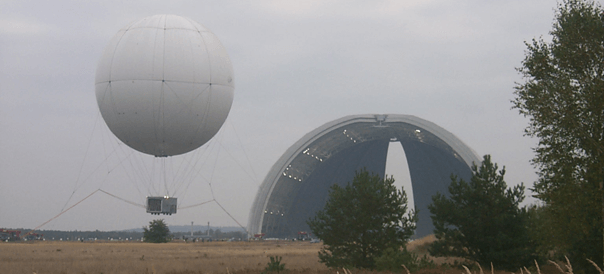
The way forward became clear at a fraction of the cost from a parallel project, instead based on a towed dumb barge spherical balloon system for 50 tonne payloads (when ground towed) or 75 tonne (when air towed). The prototype pictured right, successfully was used to transport a near 55 tonne military mine clearance tank. Its external mooring & handling arrangements also held the balloon securely through all weather conditions (including storms) 15 Apr to 10 July 2002. This arrangement was OD, where that was concluded to be a better way to follow.
It may be said that the goal for serious heavy lift operations with an airship is worthy but remains to be fulfilled, needing a viable way to proceed. LSL and its forerunners were formed to pursue new designs helping people to understand how the goal for such aircraft can be achieved.
This includes progressive methods to instead grow from small undertakings before embarking mammoth projects with huge risk; needing patience, tolerance and further market opportunities to be engaged. While small test models are unsuitable for heavy lift purposes they do cost, needing a way for payback.
OD Luffships to start with
New OD Luffships for heavy lift and other special purposes (such as high altitude variants) were first designed 2002/3 (see StratRaft & AeroRaft) and then scaled down through several steps to business entry level versions. These small versions then naturally would be representative of the much larger types to instead learn and develop from, enabling change as things then progressed. They thus are key technology development aspects necessary, including the infrastructure that hardly exists yet for mammoth types, to be developed in secure low-risk ways.
Considering the way helicopters took their place as viable aircraft, it should be clear that OD Luffships have many roles to play for similar good reasons, such as:
- Not having to face the wind direction all the time.
- Depending on configuration, ability to freely move laterally (forwards, backward or sideways), vertically, rotate and/or hold a geostationary position/altitude without rocking.
- Ability to routinely launch and be captured as-well-as operate unaided within quite small enclosed areas.
- Ability to be fixed when moored near the ground and be cloaked for protection.
- Long endurance and range, which helicopters can’t manage.
- Sustainably low noise, vibration, fuel consumption and emissions.
Although LSL has designs for spherical and natural form types (information from contact) we think the lenticular form will suit operators’ needs best. See the Derived Lenticular Types page for further information.