

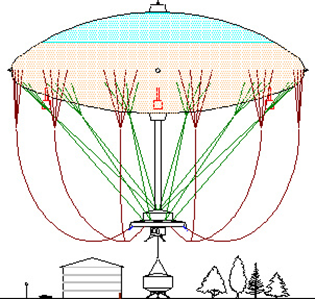
The LS-L100 dirigible concept shown left with a Ø100m lenticular aerostat was drawn to transport 10 times the payload amount (50 tonne) of the LS-L50 in a similar point-to-point way. This is possible from a combination of design scalability, configuration and improved efficiency at the greater size.
Even so, it would be a development that must satisfy higher Transport Category certification standards before entering service, involving significantly more work, time and thus cost. It thus needs the Commuter Category types to be developed first in order to increase LBA’s and associated operating teams ability, as well as to first develop international infrastructure needed for service entry; necessary to mitigate risk, avoid wasting time, and to minimise cost.
The certification standards are equivalent to those for large nonbuoyant aircraft, but probably will need regulatory specifications that better suit LBA’s omnidirectional types, which operate in simpler ways similar to rotund powered dirigible balloons. The LS-L100’s development thus not only needs an experienced and knowledgeable engineering/design team in a fully established aircraft approved organisation with operational facilities capable of undertaking the test programme but also needs the regulatory, political, business and infrastructure issues to be settled first.
The design was created by LBA’s associate LTA Solutions 2013 as an omni-directional air-porter with double the linear size {Ø100 m} for general serious ad-hoc aerial-crane lift and transport duties. As such it is smaller than the Blue Devil II airship (112.8 m long of 42,475 m3 capacity, fully built 2012 by MAV6, a now closed Mississippi defence company). However, from better volumetric efficiency, the LS-L100 has 186,210 m3 capacity – so would lift >4 times more.
It thus was a bigger project, but doable – proven by:
- the CL75 AirCrane, which demonstrated carriage of a >50 tonne payload, so possible with a buoyant aircraft and
- the Blue Devil II, which proved that a new organisation using experienced people in the art can deal with complex arrangements, as well as production of big buoyant aircraft.
Even so, it involved parallel development of new cycloidal propellers, needing attention to support the objective. This currently is a low level pursuit while specialists for them develop suitable aircraft approved designs. When ready, costs/time to develop the LS-L100 for service entry will be less than equivalent transport aeroplanes but needs backers who understand aircraft development. For further information, see its leaflet.
An Alternative Semi-buoyant Arrangement
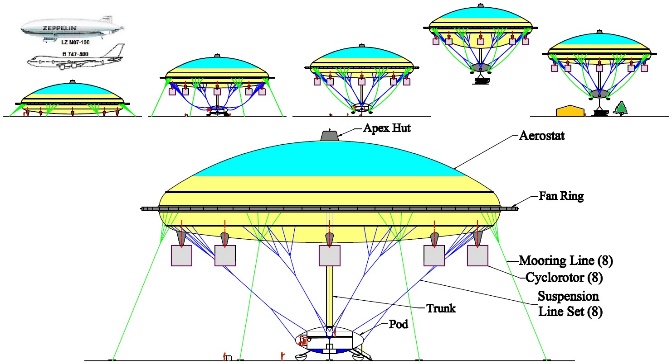
More recently, a smaller LS-L75 variant using a Ø75m aerostat was drawn up (as shown right) to minimise need for ballast exchange, going back to principles established by LTA solutions 2003. This variant enables significant aerodynamic lift for use to raise and carry payloads, minimising the time for pick&put duties – thus mitigating the danger period and improving safety while the aircraft holds a geostationary position overhead without ground restraints
Statement
We believe that unidirectional (UD) dirigible buoyant aircraft based on traditional airships designed for aerial crane and transport duties will not successfully enter regular service for a long time (perhaps 20 years or more, if ever) until they solve the issues of history. This also is because any design created must gain a type certificate from the airworthiness authorities and the aircraft to be granted a CofA before permitted to serve.
One may say this because nonbuoyant aircraft with a similar payload capacity don’t just happen in a shorter period, even when established developers already have a long track record of previous smaller types that entered service to step up from. Buoyant aircraft developers don’t have such a track record yet, evidenced by the number of airships in service today (very few and none with 50 tonne payload capability) needing significant consistent funding. Besides, where’s the international infrastructure (such as airbases) and so forth for them to enter service?
We are well aware that LBA’s proposals are not the only way for buoyant aircraft, where others propose traditional style airships and hybrid variants. We wish them success but think they will fail to meet expectations. Other types with multi-rotor arrangements also were mooted before (tried without success). Huge UD airship designs costing several $100 million at the turn of the century also were attempted without success and later attempts (like the Blue Devil II) came to nought.
We therefore think that LBA’s new way to proceed is necessary. Our plan is to develop from the ground up (instead of top down) in manageable stages and with a basic concept stepping up from simple balloons without losing omni-directional (OD) characteristics. This is instead of taking on the complication introduced over 100 years ago when unidirectional (UD) types were introduced.
We also think that people will be surprised at the way this approach is quicker as well as better able, leading to the LS-L100 entering service before other proposals are permitted to do so.
We therefore are interested to talk with people who need serious aerial crane/transport services for rather heavy outsized loads to discuss and fulfil their needs in acceptable ways. We also are interested to talk with established aircraft developers who would consider working with us under an agreed plan for the purpose. For both parties, please register interest via contact.
Together we can make a better world!


